
Managing Critical Systems When Patching Must Wait
A practical risk-management framework for protecting business-critical systems that cannot be patched immediately without disrupting essential operations.

Security teams are often told to patch quickly, and for good reason. Unsupported operating systems, obsolete applications and unremediated vulnerabilities increase the opportunity for compromise. Yet some systems cannot be patched on a normal schedule without disrupting services that customers, employees or other institutions rely on.
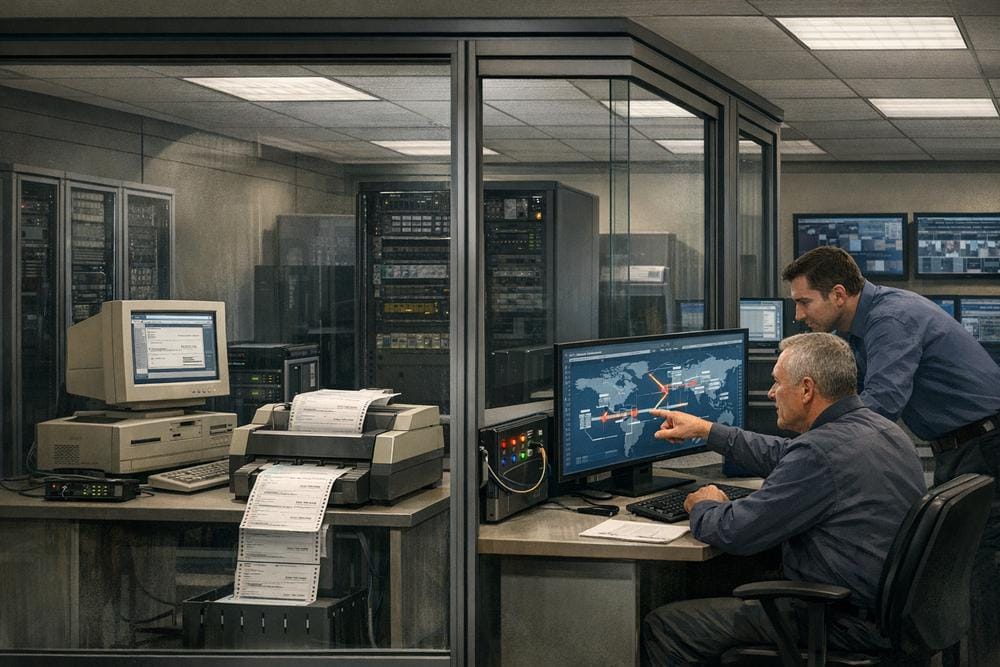
That tension is the subject of a case described by Cisco Talos in its Threat Source newsletter. The example involved a financial institution’s check-printing operation. Its specialized software would not run on current operating systems, while the printer hardware depended on older connection interfaces. The process was business-critical and had effectively no tolerance for downtime.
The lesson is not that organizations should accept vulnerable technology indefinitely. It is that patching is one part of risk reduction, and when immediate remediation is technically or operationally impossible, security teams need a documented set of compensating controls. Those controls should reduce exposure, restrict possible attack paths, improve visibility and preserve the organization’s ability to recover.
When patching conflicts with availability
Cisco Talos’ account illustrates a common problem in environments that support essential business processes. Legacy systems may be tied to proprietary applications, specialized peripherals or hardware that cannot be replaced quickly. A software upgrade can also introduce uncertainty: even if the operating system is modernized, the application, driver or device may no longer function.
In such circumstances, a simple compliance view—patched or unpatched—does not fully describe the operational risk. The organization must consider what the system does, what information it handles, how it communicates, who can access it and what would happen if it became unavailable. A system that is not internet-facing and has no routine connection to the wider corporate network presents a different exposure from an equally outdated system that accepts remote access and communicates broadly.
The first step is therefore to establish the business dependency. Security and infrastructure teams should work with process owners to document the system’s purpose, its upstream and downstream dependencies, the people who administer it, the interfaces it requires and the consequences of an outage. This is not an argument for exempting critical systems from security governance. It is a way to make the risk decision explicit and testable.
The compensating-control approach
In the example discussed by Cisco Talos, the proposed control was network isolation. The devices were placed in their own network, with access to and from the internet blocked. The design also reduced the likelihood that the systems would be discovered during an adversary’s internal reconnaissance or network mapping.
Isolation does not repair a vulnerable operating system or application. It reduces the number of ways an attacker might reach it. That distinction matters. A compensating control should be recorded as exposure reduction, not as equivalent remediation.
A practical control set for a system that cannot yet be patched may include:
- Network segmentation: Place the system in a dedicated segment and permit only the communications required for its documented business function. Avoid broad trust relationships with user, server or administrative networks.
- Internet restriction: Remove direct internet access where the process does not require it. If limited external communication is essential, route it through tightly controlled gateways and review the permitted destinations and protocols.
- Administrative access control: Restrict management access to designated administrators, approved workstations and defined maintenance windows. Remove unnecessary accounts and review privileges regularly.
- Exposure reduction: Disable services, interfaces and software components that are not needed for the system’s role. Do not make assumptions based only on the system’s age; verify which functions are actually in use.
- Monitoring: Collect available authentication, network and host telemetry. Alert on unexpected connections, new administrative activity, configuration changes and communications outside the approved baseline.
- Recovery preparation: Maintain tested backups or restoration procedures appropriate to the system. Document replacement hardware, installation media, configuration details and the manual procedures needed if the system fails.
The right combination depends on the environment. A control that is effective for a standalone printing workstation may be insufficient for a legacy application server with multiple dependencies. Controls should be validated against the actual attack paths and operational requirements rather than applied as a generic checklist.
Segmentation must be verified, not assumed
Segmentation is frequently described as a design decision, but it is also an operational control that can drift. Firewall rules change, temporary vendor access remains enabled, routing is altered and new dependencies are introduced. A network diagram that was accurate during deployment may no longer represent the system’s effective exposure.
Teams should maintain an allowlist of required connections and periodically compare it with observed traffic. The review should include inbound and outbound flows, administrative paths, monitoring systems, backup services and any vendor or support connection. Unexpected traffic should lead to an investigation, even if it does not immediately indicate compromise; it may reveal undocumented dependencies or an unintended route into the isolated environment.
Isolation also needs to account for people and removable media. A system that has no internet route can still be exposed through an administrator’s workstation, portable storage or a support process. Access procedures should define how files are transferred, how media is checked and how maintenance activity is approved and recorded. These measures should be proportionate to the system’s function, but they should not be omitted merely because the equipment is physically separate.
Monitoring legacy and fragile systems
Older systems may not support modern endpoint agents, extensive logging or frequent scanning. Aggressive security tooling can also affect availability. Monitoring therefore has to be designed around the platform’s limitations.
Network telemetry can provide useful visibility when host instrumentation is constrained. Establish a baseline for expected peers, ports, protocols and traffic volumes, then investigate deviations. Authentication events, privileged logons and changes to configuration or scheduled activity are also valuable where the platform can record them.
Security operations teams should link alerts from the legacy segment with activity on systems that administer or exchange data with it. A suspicious login on an administrator workstation, an unusual file transfer or an unexpected change to a firewall rule may be more informative than a single event observed on the isolated host.
Detection should be paired with a response plan. Define who can disconnect the system, who owns the business process, how service continuity will be maintained and what evidence must be preserved. Pre-agreed decisions reduce the risk that an incident response becomes an improvised debate over whether containment will interrupt a critical service.
Risk acceptance is not risk abandonment
There are cases in which an organization must continue operating a system that cannot be patched immediately. That decision should have an owner, a stated business rationale, an expiration or review date and a remediation roadmap. The record should identify the known limitations, the controls in place, the remaining exposure and the conditions that would trigger escalation.
Compensating controls should be reassessed when the environment changes. A new remote-support requirement, a network redesign, a merger, a change in business process or evidence of active attacks against similar technology can alter the risk calculation. The fact that a system has operated safely for years is not proof that its exposure is unchanged.
Cisco Talos’ example also emphasizes the importance of understanding the business before imposing a security change. The account describes time spent learning how the financial institution’s processes worked, including the operational significance of check printing. That context made it possible to propose isolation without treating availability as an afterthought.
What organizations should do now
- Identify systems that cannot follow the normal patch cycle. Record the technical constraint, business owner, process supported and consequences of downtime.
- Map required dependencies. Document users, administrators, applications, devices, data exchanges, backup services and support connections.
- Reduce reachability. Use segmentation and firewall policy to block unnecessary inbound and outbound communication, especially direct internet access.
- Review privileged access. Limit administration to approved personnel and managed workstations, and remove dormant or unnecessary accounts.
- Create an expected-traffic baseline. Monitor communications and investigate connections that fall outside the documented business requirement.
- Test continuity and recovery. Confirm that backups, replacement components and manual workarounds are usable before an outage occurs.
- Set a review date. Track the compensating-control decision, reassess it when the environment changes and continue pursuing a supported replacement or upgrade.
- Prepare an incident playbook. Define containment authority, business continuity actions, evidence handling and communications for a suspected compromise.
What remains unknown
The Cisco Talos newsletter does not provide a vulnerability identifier, a named threat actor, malware analysis or evidence of a specific compromise involving the check-printing environment. It also does not claim that network isolation eliminates the risk posed by obsolete systems. The example is a risk-management illustration, not a complete technical assessment of every legacy environment.
Organizations should therefore avoid treating the described controls as a universal substitute for patching. Their effectiveness depends on accurate asset knowledge, correct network enforcement, restricted administrative access and ongoing validation.
Conclusion
Critical systems sometimes cannot be patched immediately, but operational necessity should not become an excuse for unmanaged exposure. Cisco Talos’ example shows how understanding the business process can support a more disciplined response: isolate what cannot yet be modernized, restrict its communications, monitor the remaining paths, prepare for failure and maintain a clear route toward remediation.