

How COLD RELIC Turns Cloud Breaches Into Trusted Access
Google Threat Intelligence and Mandiant describe how COLD RELIC combines cloud identity abuse, stolen relationships, and targeted impersonation.

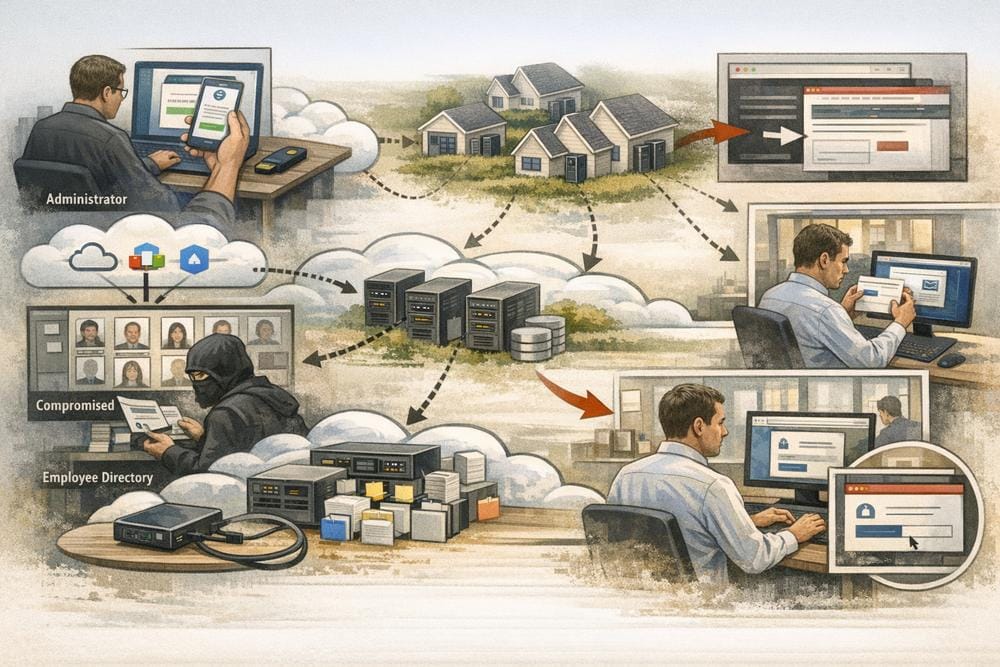
Cloud account compromise is often treated as an isolated identity incident: a stolen password, an unauthorized login, or a suspicious download. The COLD RELIC operations described by Google Threat Intelligence Group (GTIG) and Mandiant show why that view is incomplete. In the cases examined by the researchers, access to one organization became an intelligence resource for targeting another.
The Russian state-sponsored group used compromised cloud identities to collect email, employee directories, documents, and relationship information. That material then supported highly credible social-engineering approaches aimed at people connected to the original victim. The result was a campaign model in which identity compromise, data theft, impersonation, and downstream targeting formed a single operational chain.
GTIG and Mandiant published their analysis in “COLD RELIC: A Case Study in Impersonation and Compromise.” The report attributes the technical findings and incident-response observations summarized here to those organizations.
The group and the campaign pattern
COLD RELIC was formerly tracked as COLDRIVER and UNC4057 and is also known by the names Star Blizzard, Callisto, and Gossamer Bear. The supplied research describes it as a Russian state-sponsored group. The U.S. Department of Justice has assessed that the group operates within Russia’s Federal Security Service, according to GTIG and Mandiant. That is an external government assessment reported by the researchers, rather than a new attribution made in this analysis.
GTIG says it has tracked and disrupted COLD RELIC phishing activity since 2015. The group’s stated objectives include obtaining information of strategic or political value and using compromised access to reach people in the target’s wider professional and social networks. The recent investigations add detail about how that objective is pursued after an account or cloud tenant has been compromised.
The research covers two linked intrusions involving U.S.-based organizations. In the first, during late 2025, COLD RELIC compromised a cloud productivity environment and collected large amounts of organizational data. In the second, investigated in 2026, the group targeted another organization using contact and relationship context that, in the researchers’ assessment, was likely obtained during the earlier compromise.
Case one: privileged cloud access and broad collection
According to GTIG, the first intrusion began with access through a U.S.-located residential proxy network selected near the victim’s apparent location. The operators used stolen credentials for a Super Admin account and combined them with an MFA push-notification fatigue attack. After the user accepted an MFA request, the operators registered a device model that had not previously appeared in the organization’s tenant.
The attackers then established additional access by registering passkeys, MFA backup codes, and unauthorized MFA devices. These steps were significant because they gave the operators ways to return after ordinary account-remediation measures. Mandiant and GTIG specifically observed that attacker-enrolled passkeys remained usable across password and session resets and bypassed device-registration controls in the case investigated.
Using the compromised administrative privileges, COLD RELIC downloaded the organization’s cloud storage contents. The researchers observed two collection paths: files were shared in bulk with an attacker-controlled email account, and files were downloaded directly. The operators also exported employee lists and initiated a domain-wide Google Workspace Customer Takeout request.
The activity was not limited to collection. The operators accessed administrative functions, queried security investigation and email-audit logs, and viewed, changed, and deleted Alert Center notifications. GTIG and Mandiant interpret these actions as efforts to understand the victim’s visibility and remove evidence of the initial intrusion. The report maps this behavior to defense impairment and counter-investigation activity, including MITRE ATT&CK techniques T1562.008 and T1082.
Access continued for several months. During that period, the operators synchronized email through OAuth with external email clients, accessed documents concerning credentials and personnel, and searched for email archives and other material relevant to their intelligence requirements. After the group was removed, GTIG observed email accounts impersonating employees of the victim organization being used to target internal personnel and professional associates.
Case two: stolen relationships become phishing pretexts
The second intrusion illustrates why the first victim’s data mattered. Mandiant found that COLD RELIC initiated contact through an encrypted messaging application while impersonating an employee of the earlier victim organization. GTIG separately correlated a COLD RELIC redirector URL submitted to VirusTotal in June 2026 whose query parameter referenced that organization.
The researchers assess that information from the first compromise likely helped the group identify and approach the second organization. The social-engineering exchange created a familiar professional context before phishing links were shared. Those links were designed to steal Microsoft Entra ID credentials and authentication tokens, then redirect the target to document lures relevant to the ongoing conversation.
After obtaining the user’s credentials, COLD RELIC registered and used a new MFA device in the single sign-on environment. The affected organization used Entra ID as its federated identity provider for Google Workspace, allowing the group to operate across both cloud ecosystems. The operators ultimately downloaded files available through the compromised user’s cloud drive.
GTIG also observed the messaging account’s profile name change to a different person after the compromise. The organization believes this new persona was likely used for additional targeting within the same professional circles. This is an assessment, not a confirmed identification of every subsequent victim or operation.
Redirectors, parameters, and selective delivery
A recurring feature of the group’s phishing campaigns is a compromised website used as an initial link. That site redirects visitors to the actual phishing domain. The arrangement obscures the final destination and gives the operators an opportunity to fingerprint visitors before deciding whether to redirect them.
GTIG reports that COLD RELIC links often include attacker-controlled query parameters. Those values may refer to an earlier victim or to the subject of the lure. The research provides illustrative examples using placeholder domains and names rather than confirmed infrastructure. Defenders should therefore focus on the behavior: a legitimate or compromised website, an unusual redirect, and a parameter that contains a person’s name, organization, or lure topic.
The supplied research does not provide a complete list of malicious domains, IP addresses, or phishing URLs. The absence of such a list means organizations should not treat the examples as a substitute for environment-specific telemetry and intelligence feeds.
Why conventional controls can miss the activity
Residential proxies were central to the observed access pattern. GTIG says the group selected proxies that geolocated near the victim, reducing the likelihood that impossible-travel or location-based heuristics would trigger. A login from a familiar country is therefore not sufficient evidence that an authentication is legitimate.
MFA also did not prevent the compromises. Push fatigue converted a stolen credential into an accepted authentication, while later device, passkey, and backup-code enrollment created durable access. In the second case, cross-cloud federation meant that compromising an Entra ID account had consequences for Google Workspace as well.
Finally, password resets alone were insufficient in one response effort because existing sessions were not revoked. GTIG recommends treating active sessions, refresh tokens, OAuth grants, passkeys, backup codes, and enrolled MFA devices as separate access paths that must be reviewed during remediation.
Detection opportunities
The report identifies several behaviors that can be converted into monitoring priorities:
- Multiple failed MFA challenges followed by a successful login, particularly from the same source, may indicate MFA fatigue. GTIG maps the behavior to T1621.
- New passkey or device enrollment after suspicious authentication should receive heightened scrutiny. The research maps this to T1098.005.
- Unexpected OAuth authorization for broad mail scopes or unfamiliar clients can indicate remote email collection or token abuse. The report associates these behaviors with T1114.002 and T1528.
- Tenant-wide Customer Takeout creation, unusual spikes in cloud-drive downloads, and sudden external sharing should be treated as high-priority events. The supplied mappings include T1119, T1530, and T1567.002.
- Administrative exports of user lists, searches for terms such as “password,” “cred,” “.pst,” or “.bak,” and unexpected queries of audit logs may reveal reconnaissance or collection. The report maps these behaviors to T1087.004, T1083, and T1552.001.
- Deletion or modification of security alerts, especially alerts associated with the affected account, may indicate an attempt to impair defenses. GTIG maps this behavior to T1562.008.
Authentication telemetry should be enriched with residential-proxy and VPN reputation data. Defenders should also monitor abrupt changes in residential autonomous-system patterns for privileged users and investigate access from consumer networks or known proxy ranges. The research specifically mentions AS5650 and AS20115 as example ranges associated with residential proxy detection guidance; these are not presented as proof that every connection from those networks is malicious.
What organizations should do now
- Prioritize phishing-resistant MFA. Replace push, SMS, and voice-based authentication where possible with FIDO2 or WebAuthn security keys. These controls reduce exposure to push fatigue and adversary-in-the-middle phishing.
- Control authenticator enrollment. Require approval by an existing administrator or an out-of-band identity verification process before new MFA devices, passkeys, or backup authenticators are added. Alert on unexpected enrollments, especially for administrative accounts.
- Make full session revocation part of incident response. When compromise is suspected, reset passwords and revoke browser sessions, refresh tokens, and unauthorized OAuth permissions across Google Workspace and Microsoft Entra ID. Remove rogue passkeys, MFA devices, and backup codes.
- Review third-party OAuth access. Investigate unfamiliar mail clients and external services, including unexpected authorizations for broad mail scopes. Maintain an allowlist where operationally feasible.
- Reduce sensitive data exposure. Apply cloud-storage DLP policies to credentials, personnel lists, email archives, and other sensitive material. Alert on or restrict bulk external sharing and mass downloads.
- Protect trusted relationships. Train staff to verify unusual requests received through familiar messaging channels using an independent communication path. A known name or professional connection should not be treated as sufficient authentication.
- Preserve and monitor administrative telemetry. Alert on Customer Takeout requests, audit-log queries, alert deletion, directory exports, and anomalous activity from unfamiliar devices or network providers.
Conclusion
COLD RELIC’s significance lies in the way it combines cloud identity abuse with information-driven impersonation. A compromised tenant can expose not only files and mail, but also the organizational map needed to make later phishing appear routine. GTIG and Mandiant’s cases reinforce the need for identity, cloud-data, messaging, and relationship security to be managed as one defensive problem. Stronger authentication, complete session revocation, careful monitoring of administrative actions, and tighter control of sensitive cloud data can limit both the initial compromise and its downstream consequences.