

AuditTeam’s OpsAgent Turns Ransomware Into a Fake Audit
Securelist details AuditTeam’s OpsAgent framework, its dual extortion model, malware capabilities, infrastructure, and defensive detection opportunities.

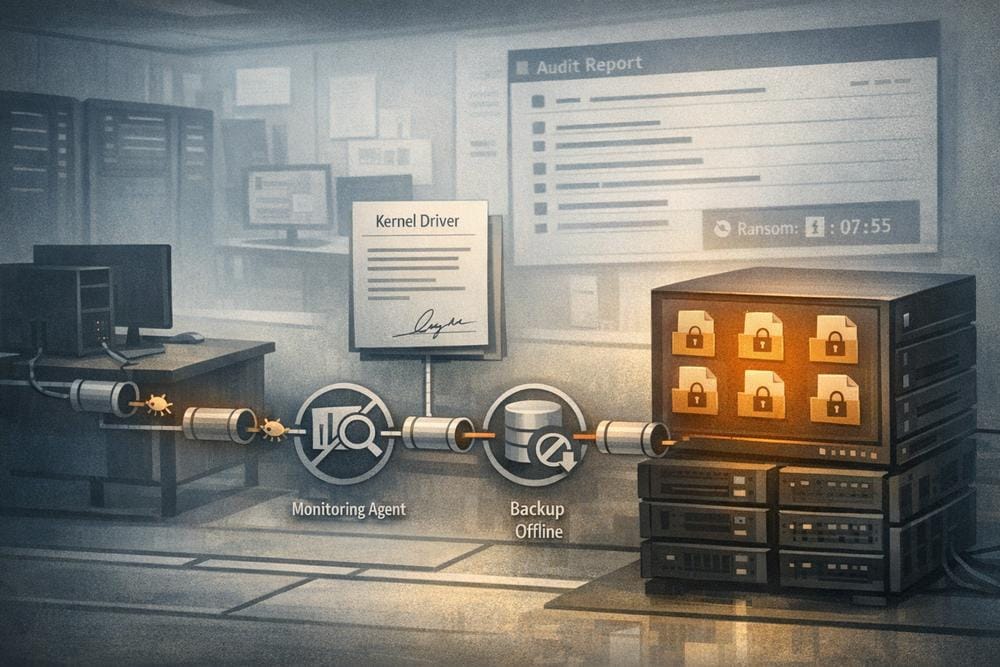
AuditTeam has built an extortion model around a deliberately misleading premise: instead of presenting itself solely as a ransomware operation, the group frames payment as a consulting or security-audit fee. In exchange, its ransom note promises a vulnerability report and claims that the stolen data will not be published.
That branding does not change the underlying activity. According to Securelist’s analysis, AuditTeam compromises organizations, steals data, disables security and backup tooling, and uses an encryption module that leaves victims unable to access files. The campaign is powered by OpsAgent, a modular Windows framework that combines remote administration, lateral movement, surveillance, payload execution, and ransomware functions.
Securelist attributes the campaign to AuditTeam with high confidence. The organization’s assessment is based on the ransom-note format, the group’s “Audit & Consulting fee” terminology, its Tor-based leak site, and the operational theme of offering remediation reports instead of simply demanding payment. That attribution remains a researcher judgment, rather than a fact independently established in the supplied material.
A ransomware chain presented as professional services
The campaign was active from at least January through October 2026, according to Securelist. The researchers observed infections in Russia, Italy, the Philippines, Hong Kong, Senegal, Finland, and China, involving organizations from different industries. AuditTeam’s leak site reportedly claimed additional victims in Turkey, Thailand, Ukraine, Argentina, South Korea, Japan, and Spain. Securelist does not identify every affected organization in the supplied research, so the complete victim set remains unknown.
The attack sequence described by the research follows a recognizable ransomware pattern, even though the group’s messaging is unusual:
- Initial compromise and deployment: AuditTeam deploys loaders that unpack and launch OpsAgent.
- Command and control: The implant receives instructions through encrypted communications, using either HTTP and then WebSocket over TLS in the Rust implementation, or WebSocket with TLS in the earlier implementation.
- Post-compromise activity: Operators can inspect hosts, run commands, move through connected agents, capture screenshots, log keystrokes, inject shellcode, and transfer files.
- Defense disruption: A specialized module can install a signed driver masquerading as a Beijing Jiangmin Antivirus component and use it to terminate security, monitoring, remote-access, and backup processes.
- Data impact and extortion: The cryptor can stop database services, remove shadow copies, encrypt files, and create a ransom note demanding the purported audit fee while threatening public disclosure of stolen data.
The supplied research does not describe the initial-access vector. It therefore cannot establish whether victims were reached through phishing, exposed services, stolen credentials, third-party access, or another route. Administrators should not assume that the malware’s presence identifies how the intrusion began.
OpsAgent is a flexible post-compromise platform
Securelist describes OpsAgent version 5.2.8 as a broad framework rather than a narrowly focused encryptor. Its worker-thread design separates command processing from connection monitoring, while background jobs run in separate processes. The implant also supports “links” to child agents, allowing operators to connect compromised systems into an agent network.
Its documented command set includes file and process management, system information collection, privilege-related actions, token operations, command-shell execution, downloads, screenshots, keylogging, and shellcode injection. The framework also includes functions for HTTP, TCP, and SMB-based connections between agents, alongside SOCKS proxying and forwarding through protocol frames. These capabilities give operators options for maintaining access and moving traffic without relying on a single direct connection from every compromised machine.
Several high-risk functions use named pipes to receive encrypted shellcode from command and control. The implant can create a process, establish a pipe, and use a host process such as msiexec.exe to execute a remotely supplied payload. The monitor function uses notepad.exe as its default host. Securelist notes that the framework does not embed some tools, including Mimikatz or pass-the-hash binaries, inside the relevant commands; instead, payloads are delivered remotely through the pipe.
The earlier loaders also show an emphasis on execution concealment. The C loader injects shellcode into msiexec.exe, while the .NET loader uses an asynchronous procedure-call technique for injection. Both were protected with OLLVM control-flow obfuscation, according to the research. A later Rust loader changed the model: it retrieves an encrypted payload, parses its PE header, and executes an export inside its own process rather than manipulating a separate process.
Infrastructure designed for flexibility
OpsAgent can obtain command-and-control information from a public GitHub repository. In the older implementation, the implant reads an encrypted configuration from the repository. Securelist reports that the repository contained both the legacy configuration format and a separate encoded blob for the Rust version.
The earlier implementation used encrypted configuration data and AES-CBC, while the Rust version changed the configuration process to AES-GCM with an HMAC-based key derivation scheme. The Rust implant initially communicates with the operator through HTTP POST requests. An upgrade command can switch it to a persistent WebSocket connection over TLS. The Rust rewrite also replaces text-based command names with numeric identifiers, adds interactive shells, directory creation, and sleep-interval controls, and removes the previous pivot-management command set.
Securelist identified AWS CloudFront subdomains as command-and-control endpoints. Because CloudFront is shared infrastructure, the researchers caution that associated IP addresses are not reliable standalone indicators. Blocking broad CloudFront address space could affect legitimate services and would not provide a precise control.
The research identifies these infrastructure indicators, displayed in defanged form:
d19v1tntmz2i98[.]cloudfront[.]netd35htktbyt7nxc[.]cloudfront[.]net157[.]20[.]104[.]111hxxps://github[.]com/RonaldCMalcolm1983/staticPage
Securelist reports that the repository remained active through November 2026, with infrastructure changes recorded through September. The repository was later removed, but the researchers note that newer Rust samples had the GitHub lookup feature disabled. Consequently, removal of the repository may disrupt some infections without proving that the campaign has ended.
Security controls are direct targets
The AV/EDR killer module is particularly significant for defenders because it attacks the monitoring layer rather than merely evading it. Securelist says the module installs a digitally signed driver presented as a Beijing Jiangmin Antivirus component. It communicates through the \KvCorePortX0 filter port and can terminate processes from a list covering security products, remote-access tools, monitoring agents, backup services, and database software.
Reported examples include Microsoft Defender-related processes, security software processes such as avp and ekrn, Sysmon, splunkd, wazuh-agent, Veeam and Acronis services, and database processes including sqlservr, mysqld, mongod, and redis-server. The supplied research says the list contains approximately 220 entries. Organizations should treat unexpected installation of a driver associated with this component as a high-priority incident, especially if security or backup services stop unexpectedly.
The cryptor module adds operational impact. It supports AES-CBC or ChaCha20 encryption, generates a distinct file key for each file, and uses X25519 key exchange. It can terminate SQL Server, Oracle, MySQL, PostgreSQL, MongoDB, and Redis processes before encryption. It also stops backup services, removes shadow copies, empties the recycle bin, and clears temporary folders. Securelist reports that deleted files may be overwritten with random data before removal, reducing the prospects for forensic recovery.
What organizations should do now
Validate security and backup integrity. Monitor for unexplained stoppages of EDR, antivirus, logging, remote-access, database, and backup services. Confirm that backup copies are isolated, protected from administrative compromise, and restorable. Test recovery rather than relying only on successful job status.
Hunt for the reported artifacts. Review endpoints for the following paths associated with OpsAgent or its supporting modules:
C:\ProgramData\Microsoft\Windows\Caches\syscache.datC:\Users\{username}\AppData\Local\Microsoft\Windows\Caches\syscache.datC:\Users\{username}\AppData\Local\Microsoft\CLR_v4.0\syscache.dat{modulepath}\syscache.dat{TempPath}\syscache.datC:\Users\Public\kv_dbg.logC:\Windows\Sysnative\drivers\kvcore.sysC:\Windows\System32\drivers\kvcore.sys
Investigate unexpected named-pipe activity, shellcode delivery into commonly abused host processes, and unusual use of msiexec.exe or notepad.exe as execution hosts. Correlate these events with process creation, driver installation, security-service termination, outbound connections to the defanged CloudFront indicators, and access to the reported GitHub repository.
Use multiple detection layers. Do not depend on IP blocking or a single malware hash. CloudFront address space is shared, and the actor has changed infrastructure and malware implementation. Combine endpoint telemetry, driver and service monitoring, process relationships, network logs, and file-integrity review. The hashes supplied by Securelist can support retrospective searches and triage, but they should not be treated as complete coverage.
Prepare the human response. A demand for an “audit” or “consulting” fee should not be handled as a normal security-services proposal. Preserve the note, affected systems, logs, and relevant network evidence. Isolate suspected hosts according to the organization’s incident-response plan, while avoiding actions that destroy volatile evidence or disconnect systems needed for containment analysis. Engage legal, privacy, executive, and recovery teams early if data theft or encryption is suspected.
Indicators of compromise
Securelist reports these file hashes for stagers: d3e49dceb89a25f5da4ff0c42e996857, bd4c327ad208cb722ad25e43ea3f35fc, 5d1425ab3dad1d2de053f69529d227e1, f0d5752054f6b7af1325ea340c4326d0, and 83768e994c6bb72d0b430b98a71ec8d. The reported driver hash is 109cdc24ccd4872a3e4bf6f2d4f3c3d4. These indicators should be validated against the original report before operational use.
Conclusion
AuditTeam’s approach illustrates how ransomware operators can borrow the language and appearance of legitimate security work while retaining the destructive mechanics of extortion. OpsAgent provides the group with a maintained, modular platform, and its transition from C++ to Rust shows continued development. For defenders, the most useful response is to focus on behavior: unauthorized driver installation, security-tool termination, named-pipe payload delivery, suspicious execution through trusted processes, backup disruption, and encryption activity. The “audit” label is a social wrapper; the technical evidence points to a ransomware intrusion that should be handled as a full compromise.