

ARMORY CASTLE’s VMware vCenter Attack Chain Explained
Google Threat Intelligence and Mandiant detail ARMORY CASTLE’s exploitation of VMware vCenter, specialized malware, credential theft, and defensive lessons.

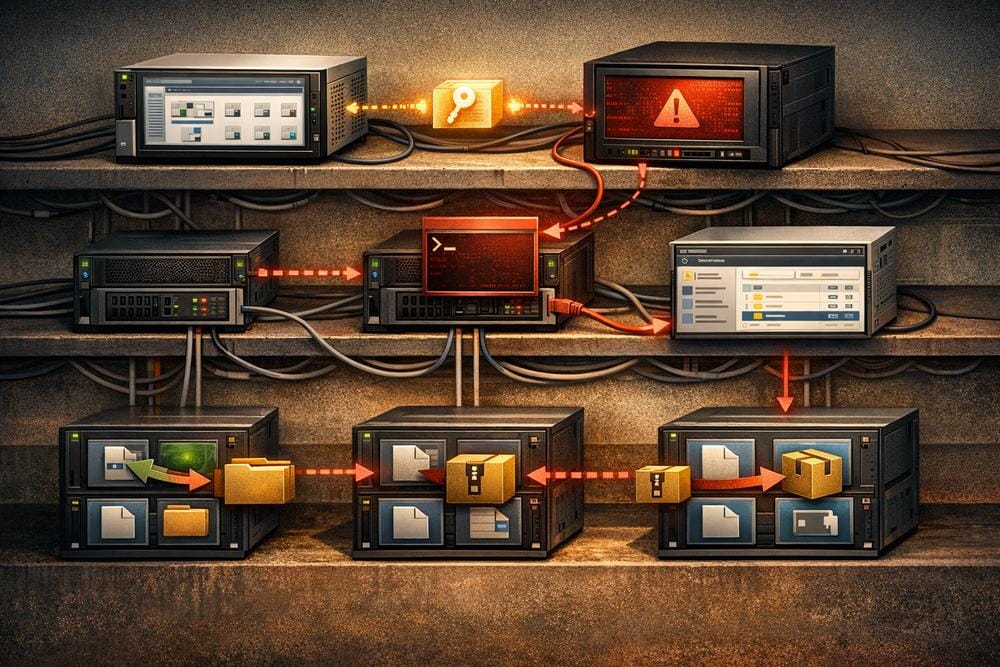
VMware vCenter is more than another management application. It is the control plane through which administrators configure, monitor, and manage virtualized infrastructure. A compromise of that layer can therefore expose hypervisors, virtual machines, credentials, and sensitive files across an environment.
In a report published by Google Threat Intelligence and Mandiant, the researchers describe a campaign attributed to the suspected China-linked espionage actor ARMORY CASTLE, previously tracked as UNC5221. The intrusion combined two zero-day exploits with malware tailored to BeyondTrust Remote Support appliances, Linux systems, VMware vCenter, and ESXi.
The report’s confirmed observations show a progression from an already compromised Remote Support appliance to an internal Linux appliance, then to vCenter and ESXi. The activity included reconnaissance, privilege escalation, authentication abuse, credential theft, persistence, and the collection of data from virtual-machine storage.
Google Threat Intelligence and Mandiant assess that the operation demonstrates substantial platform knowledge and resource investment. That assessment is based on the actor’s use of multiple purpose-built tools, including BONESAW and SAWSNAKE, as well as VMware-specific procedures. It does not, by itself, establish the identity or broader objectives of every organization that may have been targeted.
The vulnerability at the center of the vCenter compromise
The central vulnerability discussed in the report is CVE-2026-123890, which affects VMware vCenter Server. According to the researchers, it is an unauthenticated Secure Remote Password session-key disclosure issue involving the vCenter Single Sign-On and directory-service infrastructure over DCE/RPC.
Successful exploitation can provide a remote authentication bypass and create an authenticated session as administrator@vsphere.local. The researchers report that the vulnerability can then be used through the vCenter Server Directory Service interface to obtain files, including the data.mdb database.
Google Threat Intelligence and Mandiant observed ARMORY CASTLE exploiting the vulnerability in early September 2026 with a Go-based utility named BONESAW. The researchers say BONESAW could remotely retrieve and parse the directory database, extract SAML-related signing material, create an SSO administrator account, and support administrative access to vCenter.
The report distinguishes CVE-2026-123890 from CVE-2026-59309. Both involve authentication-related weaknesses, but the researchers describe different affected interfaces and exploitation mechanisms. The supplied research also states that BONESAW was used against a vCenter server that had already been patched for CVE-2026-59309, underscoring why organizations must track vulnerabilities individually rather than assume that one remediation covers related attack paths.
How the intrusion progressed
The starting point described by the researchers was a compromised BeyondTrust Remote Support appliance. That appliance had previously been accessed through CVE-2026-102764, a BeyondTrust Remote Support zero-day that was patched in update BT26-05, according to the report.
From the Remote Support system, ARMORY CASTLE conducted internal reconnaissance with a strong focus on VMware infrastructure. Mandiant observed the use of nmap and scans for ports associated with vCenter and related services, including 443, 2012, 5480, and 9080. The actor also visited VMware-related paths such as /sdk and /ui.
The actor then moved to an internal Linux appliance that did not have endpoint detection and response coverage. There, the group installed a collection of tools and malware, escalated privileges, and prepared for the vCenter operation.
The first webshell, tracked as SLIMSAVAGE, was written as ActiveSer.jsp. It provided authenticated command execution through a hard-coded secret and invoked a shell interpreter. A second webshell, CAGEMATCH, was written as u.jsp. Its primary role was staging uploaded files under /tmp. Together, the two tools supported a simple workflow: upload a payload with CAGEMATCH, then use SLIMSAVAGE to alter permissions or execute it.
Mandiant also observed ARMORY CASTLE enabling Set User ID permissions on /bin/env through the GNU Debugger. The report says this gave users the ability to execute commands with root privileges. Administrators should treat unexpected SUID changes and unusual debugger activity on appliances as high-priority events.
BONESAW and SAWSNAKE: turning access into control
After obtaining root access, the actor used curl to retrieve an archive and extracted BONESAW. The utility was designed specifically for vCenter operations. Its documented functions included remote database retrieval, extraction of SAML Security Token Service material, creation of an SSO administrator account, and support for forged administrative SAML assertions.
The report identifies filesystem artifacts associated with BONESAW, including a copy of data.mdb and exported certificate and key files. These artifacts may be especially valuable during retrospective investigation because they can show that the attacker moved beyond simple service probing and interacted with vCenter identity infrastructure.
Shortly afterward, ARMORY CASTLE deployed SAWSNAKE, another Go utility. Mandiant describes it as a tool for extracting identity-provider keys and trusted certificates, creating signed SAML assertions, and obtaining administrative vCenter session cookies. The researchers assess that this activity enabled a Golden SAML-style authentication bypass and could defeat the normal role of multifactor authentication by allowing impersonation through forged tokens.
Mandiant identified an updated SAWSNAKE sample with expanded diagnostic logging and redirect handling. The actor subsequently removed SAWSNAKE and its output files with rm, illustrating why endpoint evidence from Linux appliances should be collected remotely and promptly rather than relying only on local files.
From vCenter to ESXi and virtual-machine data
ARMORY CASTLE also deployed BEARBONES, a modified Dropbear SSH server. The report says it could bypass ordinary password validation, record plaintext credentials, and use host keys stored under /tmp. The modified service presented an SSH banner containing pulsesecure_23345. Mandiant linked that banner to a suspected network of compromised third-party firewalls and routers, although the report does not establish that every system exposing the banner belonged to the same operation.
The actor used BEARBONES to create listeners on ports 53 and 33992. The researchers then observed the creation of a local vCenter administrator account and the enabling of SSH through the vCenter Appliance Management Interface API. After connecting to vCenter over SSH, ARMORY CASTLE accessed the internal master cryptographic key and PostgreSQL password file. The SSH service was disabled after the extraction, reducing the persistence of that particular access path.
The actor next authenticated to an ESXi host using administrative credentials and SSH. Mandiant observed filesystem enumeration, inspection of mounted VMFS volumes, and the addition of an SSH public key to the ESXi root account. A hidden directory named .a was used for staging. The actor also deployed a VMware-oriented Python utility to inspect virtual disks and extract files including NTDS and Windows registry hives from guest virtual machines.
The collected material was compressed into o.tar.gz. The report says it was moved through the compromised infrastructure, with the researchers assessing that data was likely exfiltrated through the Remote Support appliance. That conclusion is presented as an assessment rather than a directly confirmed observation of the final transfer.
Persistence and command-and-control
On another Linux appliance, ARMORY CASTLE installed LAZYBONES, a Go-based backdoor previously associated with the actor. The malware used HTTPS communication with Slack for command and control, periodically checking a designated channel for messages. Mandiant observed AES-256-CTR encryption followed by Base64 encoding, polling intervals with 150-to-450-second jitter, and support for command execution, uploads, downloads, and sleep instructions.
The identified binary was /usr/bin/vmtoolscs, with persistence established through a systemd service configured to restart every 50 minutes. The use of a legitimate collaboration platform complicates network-based detection, making process, service, and unusual API activity important complements to TLS and web-proxy monitoring.
What organizations should do now
- Patch affected vCenter systems immediately. Apply the official Broadcom remediation for CVE-2026-123890 and verify that the fix is present on every applicable vCenter deployment. Also review exposure and patch status for CVE-2026-102764 and CVE-2026-59309 where relevant.
- Assume compromise when unexplained administrative changes appear. Investigate new SSO accounts, unexpected SAML or certificate material, changes to SSH access, VAMI API requests involving SSH, and modifications to ESXi authorized-key files.
- Hunt for the reported artifacts. Review for
ActiveSer.jsp,u.jsp,/tmp/123,/tmp/sss,/tmp/dbr, and/usr/bin/vmtoolscs. Search for BEARBONES’s distinctive SSH banner and for LAZYBONES-related Slack API activity. - Monitor appliance behavior. Alert on unexpected
nmap,gdb, SUID changes, downloads into/tmp, unusual archive extraction, debugger attachment, and shell activity on vCenter or ESXi appliances. - Protect the management plane with network controls. Mandiant recommends its VCSA Hardening and Logging Tool, configured and tested through formal change control. The report emphasizes granular inbound restrictions, egress filtering, remote logging, and controls that remain effective even if the VAMI or vCenter application layer is compromised.
- Improve visibility. Forward appliance logs, firewall events, authentication records, VAMI activity, process execution, and shell auditing to a remote SIEM. Do not rely solely on local history, which an intruder may delete or bypass.
- Use the supplied detections carefully. Google Threat Intelligence published YARA rules for SLIMSAVAGE, CAGEMATCH, BONESAW, SAWSNAKE, BEARBONES, and LAZYBONES, along with detection coverage in Google Security Operations. Validate rules in a test environment before production deployment.
What remains unknown
The supplied research does not identify victims by name, quantify the full scope of the campaign, or confirm the final destination of all collected data. It also attributes the activity to ARMORY CASTLE as a suspected PRC-nexus actor based on tool and technique overlap; that is a research assessment, not a public attribution by a government authority in the material provided.
Conclusion
The ARMORY CASTLE campaign illustrates the consequences of treating virtualization management as ordinary application infrastructure. Once the actor reached vCenter, authentication material, administrative sessions, ESXi access, and guest-VM files became reachable through a connected sequence of specialized tools. Patching CVE-2026-123890 is essential, but the broader defensive lesson is to isolate the control plane, monitor appliance-level behavior, restrict administrative paths, and send security telemetry somewhere an intruder cannot easily alter.
Sources
Google Threat Intelligence / Mandiant: ARMORY CASTLE Exploits vSphere