

How AI Red-Team Tools Are Reshaping Intrusion Defense
Unit 42 finds autonomous red-team frameworks accelerating attacks on exposed APIs, identity workflows, and cloud credentials.

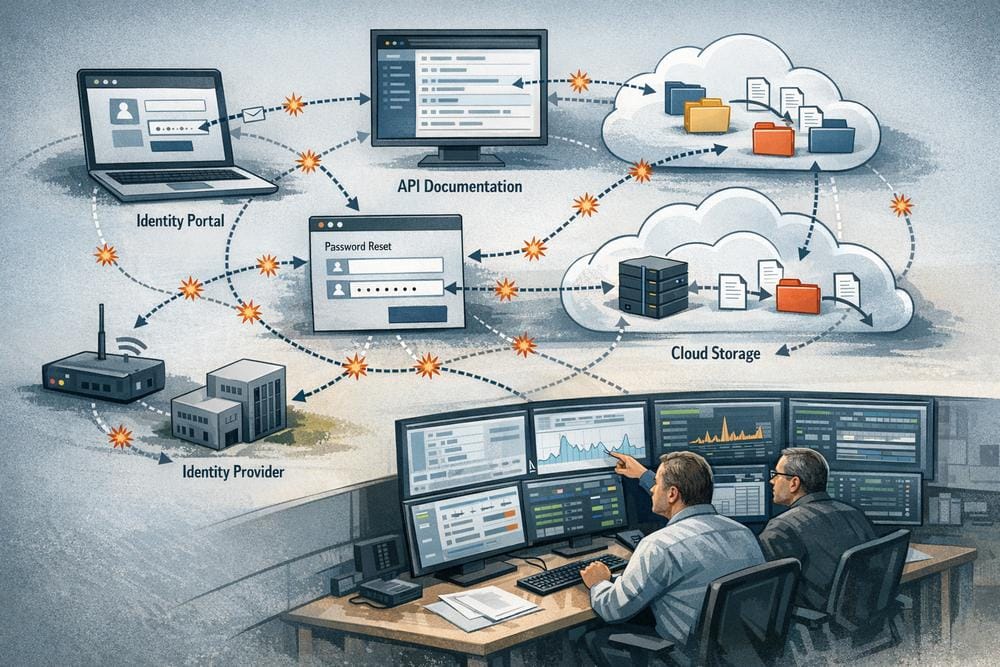
AI-assisted penetration-testing platforms are changing the operating tempo of intrusion attempts. The underlying weaknesses are familiar: exposed APIs, poorly protected account-recovery workflows, leaked configuration data, and credentials with excessive reach. What is different is that autonomous tools can examine those weaknesses continuously, adapt after failed requests, and move from discovery to follow-on activity far faster than a conventional human-led operation.
In research published November 11, 2026, Palo Alto Unit 42 described observations involving ARTEX and related AI-powered red-team tools. The organization reported intrusion attempts against multiple targets, investigations in which an attacker-controlled server hosted an ARTEX console or used infrastructure and user agents associated with the framework, and a coordinated campaign against customer cloud environments in several sectors, including retail and consulting.
Unit 42’s findings do not establish that AI has created a fundamentally new class of attack. Rather, they show how an agentic workflow can automate established abuse paths and make them more persistent, parallel, and difficult to manage through traditional alert-review processes.
What ARTEX and similar tools provide
Unit 42 characterized ARTEX as an open-source, multi-agent AI penetration-testing framework first published in mid-2026 and widely forked. The framework and comparable platforms can use a large language model to decide what to investigate, interpret responses, and choose follow-up actions. According to the research, attackers can use this loop to evaluate a failed attempt, adjust the request, and continue pursuing an objective without manually directing every step.
The wider ecosystem is not limited to one product. Unit 42 analyzed 14 tools and grouped them into four broad areas:
- Reconnaissance and attack-surface management: tools that identify exposed assets and track changes.
- Agent-led testing and vulnerability hunting: platforms that determine what to investigate and how to act on findings.
- Source-code auditing and verification: tools that look for potentially vulnerable code and supporting evidence.
- AI-system security assessment: tools that evaluate AI infrastructure, agents, tools, and model interfaces.
ARTEX and CyberStrikeAI fall into the agent-led testing category. Unit 42 reported that, as of October 2026, it identified 609 internet-facing hosts running ARTEX and 1,323 running CyberStrikeAI; 21 hosts were running both. These figures describe internet-observable deployments identified by Unit 42, not confirmed compromises.
A representative attack sequence
The reported activity centers on internet-facing identity workflows and application programming interfaces rather than a particular software vulnerability. Unit 42 said its Incident Response and Managed Threat Hunting teams observed activity across multiple organizations and sectors without exploiting a single software vulnerability. In the described pattern, an automated operator discovers public-facing functions, obtains information such as API specifications or source maps, tests identity and reset workflows, and looks for credentials or trust relationships that can provide access to cloud resources.
Once a credential or client secret becomes available, the tool can move quickly. Unit 42 observed a pivot within approximately one minute of a credential download and the validation of more than 200 client secrets in roughly three minutes. The research does not identify those secrets as belonging to a specific victim, nor does it say that every validated secret resulted in successful access.
The activity also included parallel targeting. During one period, the operator probed an application delivery controller, more than a dozen VPN appliances, a network-attached storage device, workforce identity services, and cloud ports within the same hour. This breadth is important for defenders: the operator may not follow a single linear path. It can test several exposed services at once and switch routes when one path fails.
Unit 42 also observed behavior consistent with a human remaining involved in sensitive stages. In one engagement, scripted clients gave way to a desktop browser during a password-reset operation and an initial token request. The researchers said this could indicate a human in the loop or browser automation. It should therefore not be assumed that every stage of an AI-assisted intrusion is fully autonomous.
Behavioral evidence is more durable than tool names
ARTEX is forked and modified frequently, while operators can rotate infrastructure. Unit 42 consequently emphasized behavior over static indicators. The organization identified several patterns that, when seen together, suggested an automated planner responding to the target environment:
- Bursts of one to 14 requests arriving about a second apart, followed by pauses of roughly 25 to 31 seconds, consistent with a model-inference delay.
- Rapid pivots after a credential or client-secret download.
- Requests directed almost immediately to routes found in downloaded OpenAPI specifications or source maps.
- Failed HTTP 422 requests being adjusted and retried successfully moments later.
- A GET request to the same path after nearly every successful write.
- Write-then-delete activity against storage buckets, consistent with testing whether an operation worked and then removing the test object.
- Canary inputs, including bogus usernames and placeholder values such as
evil[.]com,test[@]example[.]com, anddeadbeefdeadbeefdeadbeef12. - Repeated polling every 48 seconds for three days, along with attack sequences replayed almost identically about 30 seconds apart.
None of these characteristics alone proves that an AI system is involved. Unit 42 explicitly noted that an unusual tool configuration or a person manually testing an API could produce individual traits. The assessment becomes stronger when the cadence, self-correction, parallel targeting, and recheck behavior appear together.
Why exposed information matters
Autonomous tooling can only target assets it can discover. That makes machine-readable application information a particularly important control point. Public OpenAPI documents, source maps, configuration files, tokens, client identifiers, certificate records, and publicly resolvable hostnames can help an automated operator build an attack map with little human interpretation.
Unit 42 recommended reducing the public footprint and removing attack maps from internet-facing applications. The research also highlighted the importance of understanding which cloud hostnames and fully qualified domain names are publicly known. In appropriate environments, organizations may consider private certificate authorities and restricting origin traffic so that applications receive ingress through approved content delivery network paths only.
The same principle applies to identity workflows. Public password-reset, registration, verification-code, and account-existence functions can become high-value targets when they are weakly rate-limited or disclose too much information. Unit 42 recommended bot protection and rate limiting for these flows, removal of unauthenticated account-existence checks, and authentication on every write endpoint, including development and staging APIs.
Detection opportunities and limitations
Unit 42 described current autonomous frameworks as noisy. In a study of another tool, Cairn, the platform generated hundreds of thousands of high-frequency requests across multiple edge protocols from one origin IP address. Centralized perimeter telemetry can make this traffic distinguishable from normal user activity, particularly when network, identity, application, and cloud logs are correlated.
Detection should not depend only on a known ARTEX user agent, server address, or repository. Those indicators can change as the software is forked and infrastructure rotates. Instead, security teams should look for combinations of:
- Early probing followed by authentication, token, or cloud activity.
- First use of a cloud key from a new source address.
- Canary usernames appearing in identity-provider logs.
- Rapid testing of many client secrets or identity endpoints.
- Storage writes followed shortly by deletion.
- Machine-paced request bursts, inference-like pauses, automatic retries, and regular polling.
These signals are most useful when compared with approved testing windows and known security-team infrastructure. MSPs and service providers should maintain an inventory of authorized penetration-testing sources, tools, and schedules so that high-volume activity can be verified rather than automatically trusted or ignored.
What organizations should do now
- Inventory the external attack surface. Identify public APIs, reset and registration workflows, staging systems, cloud endpoints, certificate records, storage services, VPN appliances, and identity-provider integrations. Remove or restrict assets that do not need to be public.
- Remove machine-readable secrets and maps. Review OpenAPI specifications, source maps, configuration files, deployment records, and public documentation for tokens, client identifiers, or other information that simplifies automated targeting.
- Protect every state-changing operation. Require authentication and authorization on write endpoints, including nonproduction environments. Apply rate limits, bot controls, and abuse monitoring to account recovery and verification flows.
- Harden federated identity. Unit 42 recommends blocking local passwords for workforce accounts in customer and partner identity providers and ensuring that password recovery cannot unlink a federated identity.
- Reduce credential reach. Replace long-lived cloud keys with role-based access where practical, keep administrator credentials out of provisioning records, store function secrets in a secrets manager, and apply least privilege to workload roles and functions that can create roles, keys, or tokens.
- Correlate behavior across control points. Join edge, application, identity, endpoint, and cloud telemetry. Investigate early reconnaissance when it is followed by credential use, token requests, or cloud changes.
- Test defensively under authorization. Unit 42 assesses that teams can use comparable open-weight offensive frameworks in controlled environments to identify and remediate exposed workflows before external agents find them. Such testing should be governed, isolated, and clearly separated from production attack activity.
Unit 42 also discussed defensive deception as a possible supplementary measure. Because LLM-driven tools use target responses as context, identical generic errors and silent connection throttling may deprive an agent of useful feedback. This is not a substitute for authentication, exposure reduction, or monitoring, and it should be evaluated carefully to avoid harming legitimate users and operators.
What remains unknown
The supplied research does not provide a CVE, a named threat actor, a complete victim list, or a definitive claim that every observed operation was controlled entirely by an AI system. It also does not establish that the described activity resulted in data theft or broader impact in each organization. The strongest conclusion is narrower: Unit 42 observed intrusion activity with behavioral characteristics consistent with autonomous planning, sometimes combined with human interaction, and found that established exposure and credential weaknesses could be tested at machine speed.
Conclusion
AI-powered red-team frameworks lower the effort required to run persistent, adaptive intrusion attempts. Their strategic significance comes less from novel exploits than from their ability to discover exposed workflows, retry intelligently, validate credentials, and pursue multiple paths in parallel. Defenders should therefore prioritize external exposure management, strong identity controls, credential minimization, and behavior-based detection. Tool names and infrastructure will change; the observable sequence of discovery, rapid adaptation, credential use, and repeated verification is more likely to remain useful.
Sources
Palo Alto Unit 42: ARTEX and AI-Powered Red Teaming Tools: What Defenders Need to Know