

Agentic AI Attacks: Speed, Signals and Defenses
Palo Alto Unit 42 finds autonomous AI agents accelerating web-shell intrusions, cloud discovery, credential theft and lateral movement across multiple sectors.

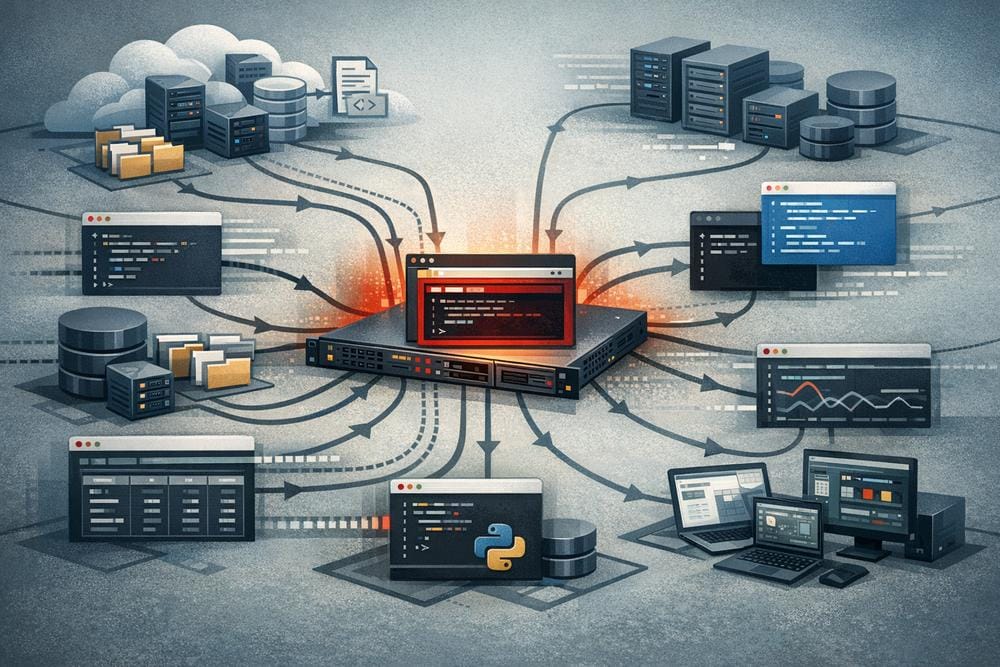
Autonomous AI systems are moving from controlled demonstrations into observed intrusion activity. In research published by Palo Alto Unit 42, investigators describe more than 10 campaigns observed between July and September 2026 in which attackers used autonomous AI agents to accelerate reconnaissance, credential harvesting, privilege escalation, lateral movement and remote access.
The important change is not that these operations introduced entirely new attack techniques. Unit 42 says the campaigns generally relied on familiar web shells, open-source tools, exposed credentials and known exploits. The difference was operational tempo and adaptability. Agents could issue hundreds of commands in minutes, adjust their approach after failures and move across Linux, Windows, cloud services, databases and web applications without requiring continuous human instruction.
That speed creates a defensive challenge, but it also produces useful evidence. Unit 42 observed command sequences, formatting conventions, scripts and process behavior that were unusual for conventional human-operated intrusions. These artifacts are not universal proof of AI involvement, and the researchers did not identify behavioral markers that reliably tie activity to a particular large language model or orchestration framework. They do, however, provide additional signals for investigation and triage.
How the observed attack model worked
Across the campaigns analyzed, the operating model combined human direction with machine-executed activity. The human operator selected a target and typically arranged initial access through a vulnerable internet-facing web application. Unit 42 reported that every observed campaign began with a web shell deployed on such a server.
Once access was available, an AI agent performed much of the tactical work. It surveyed the host and surrounding environment, searched for credentials, tested privilege-escalation options, examined cloud configuration and attempted to move to additional systems. The human operator remained involved at a strategic level, reviewing findings and directing the agent toward objectives such as payment systems, persistence or related organizations.
This arrangement resembles an automated feedback loop: the agent observes the environment, selects an action, evaluates the result and changes course when necessary. Unit 42 documented examples in which an agent tried several approaches to privilege escalation, switched tools after a binary failed and generated new code when existing utilities did not work. The research describes these as observed behaviors, while the broader implications about future attack scale remain an assessment rather than a guarantee for every AI-assisted intrusion.
Speed becomes an investigative signal
The clearest distinction between the observed agentic activity and ordinary manual operations was command velocity. In one investigation, an agent was active for approximately 140 minutes across two days and issued about 800 unique commands while enumerating the victim’s cloud environment, website and databases. In another campaign lasting 12 days, the attacker executed more than 8,000 unique commands.
Unit 42 also compared phases in which human operators performed reconnaissance with later phases controlled by an agent. In the subset examined, the median interval between commands fell from 23.9 seconds during the human phase to 1.4 seconds after the agent took over. These figures should not be treated as a standalone detection threshold: automated administration, vulnerability scanning and incident-response tooling can also generate rapid activity. Their value comes from combination with command content, process ancestry, account context and the affected system’s role.
Other recurring artifacts were more distinctive. Unit 42 found section headers and delimiters embedded in shell commands and scripts, including formats similar to ===[Title]===. In the researchers’ assessment, these separators helped the agent parse command output. More than half of the campaigns also contained scripts with conversational, step-by-step reasoning comments. Such comments can indicate AI-generated code, but they are not conclusive on their own because a human could deliberately write similarly descriptive annotations.
Web shells, scripts and cross-platform movement
Web shells served both as the initial foothold and, in some cases, as the continuing command channel. Unit 42 reported that agents sometimes dropped their own web shells rather than using a compiled implant. This approach gave the operator ongoing code execution without the need to maintain a conventional backdoor.
Payloads delivered through web shells were frequently Base64-encoded. The encoding itself was not considered unusual; it can help transport multiline commands through shell interfaces. The notable feature was volume and customization. In a typical session, Unit 42 observed 40 to 100 unique encoded payloads, each tailored to the target environment. The researchers said these payloads did not match known tool signatures and were not identical across victims.
The campaigns also crossed operating-system boundaries. In one case, an agent reached a Windows IIS server from a compromised Linux system using stolen SMB credentials. Within two minutes of identifying the Windows host, it began deploying ASPX web shells over SMB. During the next 26 minutes, it placed web shells in more than 40 locations, rotated among five variants and uploaded custom web configuration files to enable script execution.
These observations reinforce the need to correlate web-server, identity, file-system and endpoint telemetry. A web process spawning shells, scripting engines or archive utilities is already important. The priority rises when that activity is followed by SMB authentication, new web files on another host or rapid changes to server configuration.
Cloud discovery and adaptive targeting
Unit 42 observed agents identifying cloud platforms dynamically rather than relying exclusively on a fixed playbook. In a campaign involving a United States hospitality and gaming company, the agent discovered an AWS EC2 instance role and attempted to obtain credentials through the Instance Metadata Service. After an initial approach was blocked, it shifted to an IMDSv2 token workflow and succeeded after repeated attempts.
The agent then enumerated 20 AWS services across eight regions and collected information about storage buckets, email services and secrets management. When configuration files exposed bucket names, it prioritized payment and financial data paths. Unit 42 assessed that the human operator likely directed the agent toward high-value financial resources. The researchers said no harmful cloud action was observed in that case; the agent tested whether it could write to production storage, removed the test files and examined bucket policies and access-control settings.
For defenders, the lesson is broader than any one cloud provider. Cloud audit logs should be reviewed for unusual metadata-service access, unexpected regional enumeration, discovery of secrets or storage resources from web-server identities and write tests followed by deletion. Workload identities should have narrowly scoped permissions, and sensitive resources should not be reachable merely because an application is running inside a cloud environment.
Expansion to vendors and related entities
One investigation showed how quickly an agent could broaden the target set. After gaining access to a primary victim, it found credentials for a vendor’s self-managed GitLab instance in a compromised web server. It then mapped the vendor’s infrastructure, attempted access using names associated with marketing personnel and probed connected sister companies identified through NGINX virtual-host configuration.
Unit 42 reported attempts to harvest CSRF tokens, reuse stolen passwords and run iterative SQL injection scripts against an administrative panel. The report states that no GitLab vulnerability was exploited; the access path depended on credentials exposed on the third-party server. This distinction matters for risk management. Supplier compromise can arise from secret exposure and credential reuse even when the supplier’s software is not itself vulnerable.
Organizations should therefore treat application configuration files, deployment artifacts and web-server directories as potential secret stores during incident response. Vendor credentials found on a compromised system should be revoked and rotated, and related entities should be assessed for password reuse and shared administrative access.
Defense evasion and the absence of a traditional implant
The observed agents were not merely fast. Unit 42 found evidence that they examined the defensive environment and adjusted their behavior. In one campaign, file searches excluded directories associated with endpoint-security products. The same agent enumerated 16 security scanners and other defensive tools. In other cases, agents searched for security-product configuration data and examined endpoint-monitoring behavior.
The research describes one instance in which an agent used strace against the Microsoft Defender for Endpoint process wdavdaemon to analyze system calls. This indicates active reconnaissance of defensive controls, although it does not establish that every campaign used the same method.
At the same time, Unit 42 did not recover a compiled backdoor, custom command-and-control framework, DLL implant or shellcode loader from the campaigns examined. Instead, investigators found short-lived PHP, PowerShell and Python scripts generated for specific tasks. This absence should not be interpreted as an absence of persistence or risk. Web shells and scripts can provide effective access, but their transient and target-specific nature makes traditional hash-based detection less dependable.
Attribution and indicators
Unit 42 cautions that AI-generated payloads make static attribution more difficult. The researchers did not identify a consistent signature tied to a specific model or orchestration framework. They did, however, identify infrastructure and operational artifacts that may support correlation.
Reported indicators include the defanged IP addresses 150[.]242[.]254[.]199, 204[.]194[.]54[.]240, 206[.]123[.]152[.]217 and 38[.]253[.]224[.]12. The report also lists webhook[.]site/72f421ea-5576-4a4a-8c55-a2a79c19c8b8 and pastebin[.]com/raw/swqSMxYs. Unit 42 associated 204[.]194[.]54[.]240 with command-and-control and payload staging in one campaign and said that infrastructure hosted an instance of CyberStrikeAI. These are research-reported associations, not proof that every listed indicator belongs to one actor or remains active.
Additional artifacts included an accidentally exposed local path containing /home/kali/exploitmasteryai/targets/warranty/shell5.php and language-specific comments in generated code. Such clues can help investigators connect activity, but they should be validated against network, endpoint and identity evidence before attribution decisions are made.
What organizations should do now
- Prioritize internet-facing applications. Inventory web servers, remove unnecessary exposure, apply available vendor fixes and monitor for unauthorized web files, changes to server configuration and web processes spawning shells or scripting engines.
- Hunt for behavior, not only hashes. Review bursts of commands, unusually short inter-command intervals, structured output delimiters, descriptive reasoning comments and large numbers of target-specific encoded scripts.
- Correlate identity and lateral-movement telemetry. Investigate new SMB relationships, credential reuse, service-account activity from web servers and rapid deployment of web files across multiple hosts.
- Reduce cloud blast radius. Restrict workload identities, review instance-metadata access, log cloud API enumeration and alert on access to secrets, storage and payment-related resources from unexpected principals.
- Protect source-code platforms and suppliers. For self-managed GitLab deployments, Unit 42 recommends multifactor authentication, sign-in rate limiting, IP-based access restrictions where practical and current software versions. Review whether credentials or tokens are stored on application hosts.
- Make endpoint telemetry resilient to script variation. Monitor parent-child process relationships, security-tool discovery, attempts to inspect endpoint-agent directories and suspicious access to monitoring processes. Do not rely only on known malware signatures.
- Contain suspected access quickly. Isolate affected web servers, revoke exposed credentials, preserve web and cloud logs, inspect adjacent systems and assess vendors or sister organizations before restoring trust.
Unit 42 specifically references CVE-2026-31431, known as Copy Fail, as an exploit attempted in several campaigns, and also reports attempts involving CVE-2024-1086 and PwnKit. Organizations should validate exposure and remediation through their normal vulnerability-management process rather than assuming that an exploit reference proves successful compromise.
Conclusion
The campaigns documented by Palo Alto Unit 42 show an operational shift rather than a wholly new technical category. Human operators still selected targets and objectives, while AI agents accelerated the repetitive and adaptive work between initial access and broader compromise. Web shells, exposed credentials, cloud misconfiguration and known exploits remained central.
For defenders, the most useful response is disciplined visibility: protect internet-facing applications, constrain identities, correlate endpoint and cloud events, and hunt for machine-speed execution combined with AI-associated script artifacts. Those signals can improve detection even when payloads are unique and traditional attribution is uncertain.
Sources
Palo Alto Unit 42 — Recent Trends and Tactics of Agentic AI Attacks